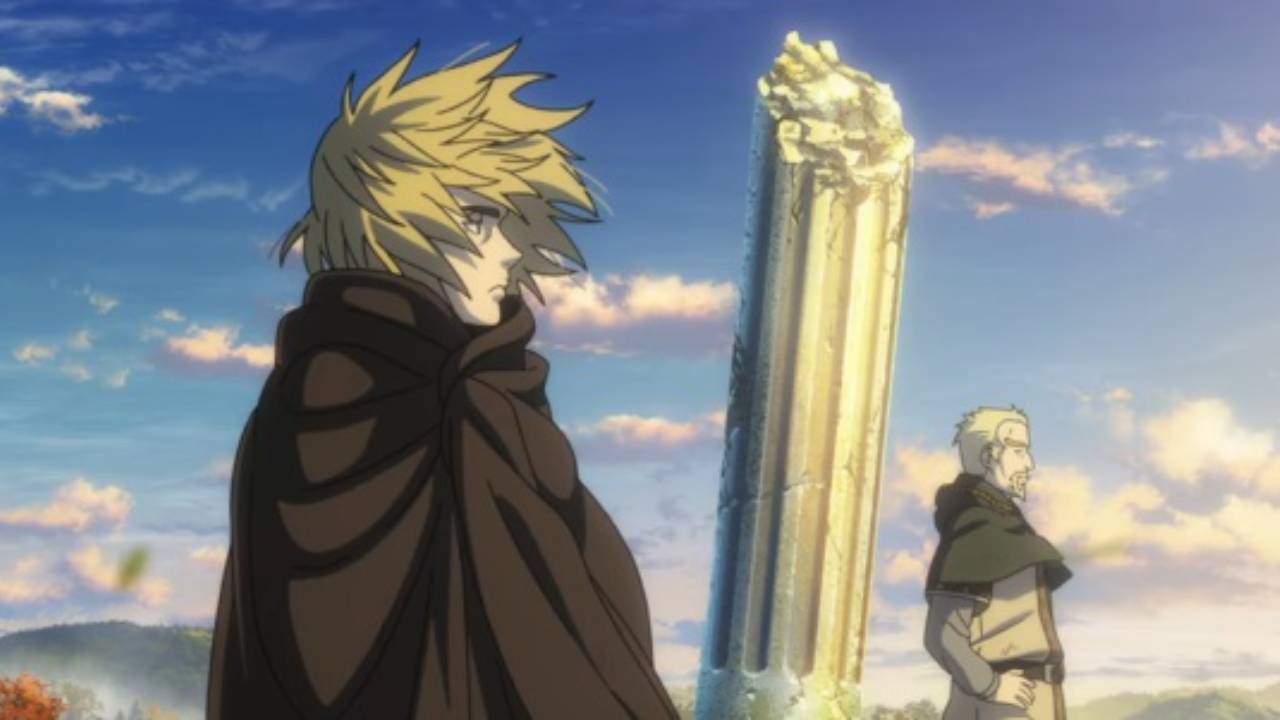
Vinland Saga is a 2019 animated series by the Japanese studio Studio Wit adapted from the manga of the same name. Although its first season is but the prologue to a larger story, it nonetheless presents a vivid criticism of violence and revenge. Set within the viking culture of the early eleventh century and primarily during the Danish invasion of England in 1013 and 1014, Vinland Saga explores what it means to be a “true warrior:” someone who fights for peace without needless violence. These aspects of the story are conveyed through the words and actions used together by various “warriors” throughout the season—at its center is our main character, Thorfinn, a vengeful boy who spends the majority of his childhood traveling and fighting alongside Askeladd, the very man who killed Thorfinn’s father.
The question of what being a “true warrior” means is embodied by Thorfinn’s father, Thors. He is much in line with epic heroes like Beowulf—overwhelming strength unrivaled by anyone alive. Where he differs, however, is that after years of killing as part of the elite Jomsviking order, he rejects it altogether, deserting the battlefield to live a peaceful, pastoral life with his wife and children in Iceland. This denouncement of killing is what sets Thors on the path to becoming a true warrior, encapsulated by two of his lines: “No one has enemies” and “A true warrior needs no sword.” The first is said to a young Thorfinn, who wants a sword to kill “enemies” overseas. Thors fails to convince Thorfinn with those words, as his works seemingly do not line up with them; Thors is leaving the village to go to war, and in Thorfinn’s mind that means “enemies” must exist. Yet that is not to say Thors has “enemies”—Thors only leaves to protect the village, threatened by the very Jomsvikings who called him to war. In episode 4, Thors remarks that a “true warrior needs no sword” in the Faroe Islands, where he single handedly fights Askeladd’s crew. Thors recognizes that he is “imperfect.” While Thors ended the conflict, he did so through violence: incapacitating most of Askeladd’s men with his bare hands and defeating Askeladd in a duel while relying on the sword he used as a Jomsviking. But not one of those men died. Instead, Thors throws away his sword, trading his death at the hands of Askeladd for the lives of his companions and his son. A “true warrior” doesn’t need a sword to win a battle—only his words and his actions.
Thorfinn, unable to understand his father’s words, is consumed by revenge and hatred for Askeladd, who he sees as his “enemy.” This single-minded notion impedes Thorfinn from following in his father’s footsteps and becoming a “true warrior.” This is expressed through the disconnection between Thorfinn’s words and actions. Thorfinn doesn’t use many words after his father’s death—the words he does use, however, are often levied at Askeladd, “boasting” about killing him. Though Thorfinn is unable to fulfill this boast because of his rage and anger towards Askeladd; the very driving force behind his boast in the first place. This is evident in one of their early duels in episode eight, for when Askeladd purposely insults Thors during the battle, Thorfinn becomes enraged further and thus easier to read. Thorfinn can only defeat Askeladd if he lets go of his anger; but letting go of that anger removes his reason to kill Askeladd, his “enemy,” trapping Thorfinn in a cycle of violence that stops him from becoming a “true warrior.” Thorfinn’s “heroic feats” are also devoid of boasts. The “boasting” that epic heroes such as Beowulf perform imply that the hero wants to perform the feat in order to increase their fame and glory. Thorfinn, on the other hand, does not want to perform these feats of strength, and cares not for glory. Instead, he begrudgingly accomplishes such feats at Askeladd’s command in order to prove himself worthy of a duel and avenge his father. In the pursuit of violence against a single man, Thorfinn is forced to commit innumerable violences against many people: yet his inability to kill his “enemy” or give up on revenge ensnares him in a cycle of murder far from the ideal of a “true warrior.”
Askeladd is a character that I could write an entire paper on, but for the purpose of this review I shall focus on how his view of nearly everyone else as an “enemy” is reflected in his careful and deliberate use of words. Askeladd’s view is a result of his half-Danish and half-Welsh heritage. Although he fights alongside the Danish people, has a crew made up of Danes, and even pledges his service to the Danish Prince Canute, he sees all of them but Canute as his “enemies,” the opposite of the “true warrior:” Askeladd’s Danish father mistreated his enslaved, Welsh mother said to be descended from Artorius. Askeladd sees himself as Welsh, yet proclaims his heritage differently depending on the people around him. In the presence of the Danes, Askeladd proclaims himself to be the “son of Olaf,” asserting his Danish heritage to be seen as one of them. In Wales, Askeladd proclaims himself as the “son of Lydia” to gain passage through the land. This dichotomy is directly addressed by the second to last episode of the season, where after Askeladd expresses to Thorkell that the land of Wales is his “home” and “country,” he is called by an attendant of the Danish King Sweyn “Askeladd, son of Olaf.” Though he sees himself as Welsh, Askeladd had successfully deceived the Danes into believing his Danish identity through his purposeful choice of words and works—or did he? King Sweyn declares that the Danes shall invade Wales the following spring, and additionally speaks about Wales directly to Askeladd—the same method used by Askeladd in his duels against Thorfinn. However, Askeladd doesn’t immediately get angry, instead using his words as a Danish thegn of Canute to try to convince Sweyn not to invade Wales, which seems to be in line with the “true warrior” way of using words to avoid conflict; but as Askeladd is not one, Sweyn being the very definition of his “enemy,” such words cannot sway him. Askeladd, in a whisper from the King, is given the choice between Canute or Wales, and chooses to save both of them. The way Askeladd does so, however, violates the ideal of the “true warrior,” for he resolves it with a violence even greater than the violence used by Thors in their duel: Askeladd feigns insanity by declaring himself the rightful king of England and beheads King Sweyn, stopping the conquest of Wales and securing Canute’s rule over England, placing all the blame for the incident on himself. Even in the most dire of situations, Askeladd’s words are carefully chosen and supported by works in order to protect his “allies” from those he sees as his “enemies.” Yet by using violence to do so, Askeladd could never reach the status of a “true warrior.”
This ideal of the “true warrior” is reached by a character other than Thors—Prince Canute, son of the Danish King Sweyn. He doesn’t know how to properly use his words as a member of Danish royalty at first, and must learn by discovering the meaning of what it means to be a “true warrior” through different means than Thors. Prior to episode eighteen, Canute is reluctant to speak, as he knows that the words of royalty hold more power than a normal person. However, it is that same reluctance that holds him back from becoming a “true warrior” worthy of the Danish crown. As Askeladd remarks to Canute’s attendant, Ragnar, “If he [Canute] never speaks up, how can he hope to someday take the Danish throne?” While the words of royalty are powerful, they must be used in order to learn how to use them: if one doesn’t speak, one will not know how to speak. This is clear in episode thirteen: when Canute explains to Thorfinn why he can’t speak haphazardly, he stutters, afraid of the words he is speaking—for he doesn’t know how to use them. This all changes in episode eighteen, when Canute has an epiphany about God that leads him on the path to a “true warrior.” (We know that such is the result because Thorkell the Tall believes that Canute’s eyes look similar to Thors’s.) Yet while Thors reasoned that no one has enemies, Canute reasons something else: that humans are devoid of “love.” This is God’s love, something different from the love humans have between each other. The dialogue between Canute and the priest that accompanies them reveals this fact. Human love is not love: it is discrimination, as there is a prioritization of one person over another. “Love,” as the priest relates, can only be reached by humans in death, which “completes a man,” for it was lost because of original sin. As a result of this epiphany, Canute is no longer afraid to speak, naturally giving orders with conviction: if there is no meaning in human life other than to die, as a king, Canute must use his words and works together to give the lives of his subjects meaning, creating the paradise God withholds from men on earth itself.
The season ends on Canute assuming command of the English throne and Askeladd’s death—but at the hands of Canute, not Thorfinn. This liberates Thorfinn from the cycle of violence he was trapped in, but places him in a precarious position going forward, as what he had been fighting for all this time was for naught: there was no need for revenge and violence at all. What I am excited to see in the next season is where Thorfinn shall go from here, and how he will become a “true warrior.” Such is what Askeladd told Thorfinn in his final words, imploring him to give up on revenge, follow in the footsteps of Thors and “become a true warrior.” Perhaps Thorfinn will be able to surpass his father, seek peace without the need for violence, and finally learn to use his words and works effectively; while all the while trying to find that purpose after everything he worked towards was taken away from him.